Written by Brad Kittredge,
Brightside Health
7 Minute Read
This article is part of The Quality Blueprint—a series focused on defining what it takes to deliver safe, high-quality, and effective virtual mental health care.
Clinicians shape every behavioral health care experience. They build the therapeutic relationships that drive engagement, make the clinical decisions that direct treatment, and ultimately influence whether patients improve.
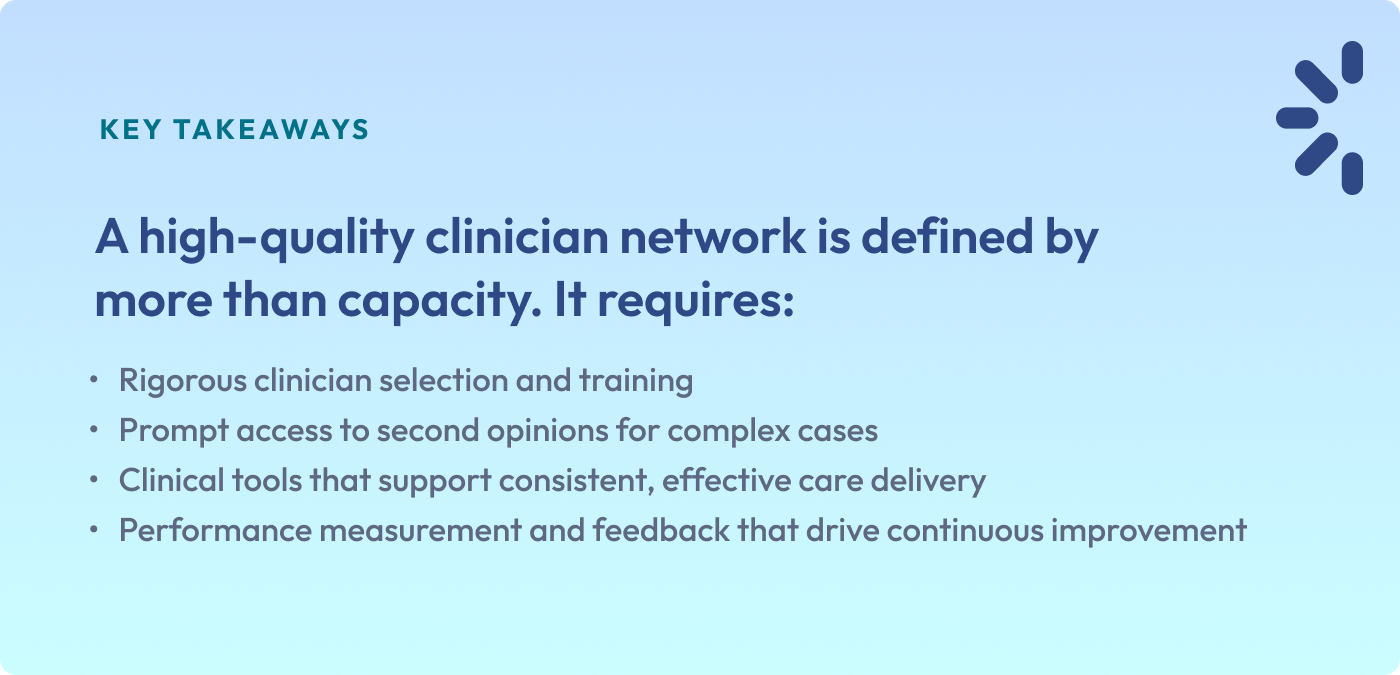
For many provider groups, network development has focused primarily on scale—but today’s care environment requires more. How deliberately clinicians are selected, trained, and supported is what separates a high-performing network from one that simply grows in size. This piece outlines the benchmarks required to build and sustain a strong clinician network at scale.
Operationalizing clinician network quality: The benchmarks that matter
An actively curated and deployed network—built with thoughtful selection, training, support, and development—drives better clinical outcomes and lower costs. The benchmarks below define what that requires in practice.
You can assess your own organization or see how Brightside stacks up against these benchmarks in the Mental Health Quality Scorecard (MHQS).
Hiring, credentialing, and network composition
MHQS benchmarks: Hiring practices, credentialing, licensure & location, diversity
A larger clinician network isn’t always better. Building a network with quality and consistency in mind is critical for high-quality care delivery.
- Hiring practices: Rigorous hiring requires clear and firm criteria for behavioral health credentials, relevant clinical experience, and a clean record—applied consistently across the network. Every clinician should also complete a structured interview, conducted or reviewed by clinical leadership, to assess interpersonal qualities and care approach that credentials alone can’t capture.
- Delegated credentialing: Best practice credentialing requires verifying credentials directly with the licensing board. Background checks must be comprehensive and disciplinary histories actively reviewed. License status must be re-verified at least every six months for every active clinician.
- Licensure and location: Clinicians must only deliver care to patients in states where they hold an active license. Systematic controls and safeguards are required to ensure every patient receives compliant care.
- Therapeutic alliance: Therapeutic alliance is one of the strongest predictors of treatment outcomes. Building it requires clinicians who can connect with patients across lines of culture and lived experience. Clinicians should be selected for their thoughtful, compassionate approach and trained in culturally responsive care. An intentionally composed network also offers meaningful diversity across gender, ethnicity, and language—set and measured relative to the patient population being served.
Clinician training and ethics
MHQS benchmarks: Clinician training, code of ethics
Every clinician brings a different background, clinical experience, and familiarity with a remote environment. A clear training baseline helps ensure consistency across the network.
- Shared clinical foundation: Before seeing patients, clinicians should complete extensive training spanning clinical protocols, regulatory requirements, technology, and the operational processes that support day-to-day care delivery. Onboarding is also an opportunity to establish the network’s clinical culture—with a Code of Ethics that defines expectations around patient safety, confidentiality, and scope of practice.
- Telehealth-specific clinical preparation: Virtual care introduces distinct clinical considerations—reading patient affect through a screen, managing crisis situations remotely, and building and maintaining the therapeutic relationship in a digital context. Clinicians benefit from learning these best practices upfront and through ongoing collaboration with peers.
- Continuing education: High-quality, relevant CEU training should be available to all clinicians. Ongoing education reinforces clinical competency and keeps care delivery aligned with emerging best practices.
Clinical support and oversight
MHQS benchmarks: Clinical oversight, compliance, identity verification
Clinicians are licensed professionals, expected to exercise sound clinical judgment in every encounter. The role of clinical leadership is to support and strengthen that judgment—through oversight, consultation, and tools that make informed clinical decisions easier.
- Escalated case consultation and second opinions: Complex cases—those involving diagnostic uncertainty, treatment resistance, elevated suicide risk, or comorbid conditions—require timely access to second opinions and escalated consultation. Clearly defined pathways ensure clinicians can access the right expertise quickly, supporting better outcomes for high-risk cases.
- Clinical tools and decision support: The systems clinicians work within directly affect the quality of care they deliver. Purpose-built behavioral health EHRs support the right clinical workflows and data gathering—while efficiency tools like clinical note suggestions reduce administrative burden without sacrificing documentation quality. Clinical decision support can reduce variability in complex decisions like medication selection—bringing greater consistency when precision matters most.
- Collaborating clinicians: Clinicians with regulatory supervision requirements, including PMHNPs overseen by psychiatrists, benefit from oversight that goes beyond a minimum standard. When well-designed, it creates a feedback loop that strengthens clinical judgment and improves care quality. Documented compliance protects patients, clinicians, and the organization.
- Clinician identity verification: In a fully virtual environment, verifying that the credentialed clinician assigned to a patient is the one delivering care is a fundamental requirement. Multi-factor authentication and automatic identity verification ensure that access controls are maintained at the point of care.
“Clinicians do their best work when they are well-supported. That includes structured onboarding, access to consultation for complex cases, and tools that make informed clinical decisions easier. These factors directly influence patient outcomes.” – Chief Medical Officer Mimi Winsberg, MD
Performance and development
MHQS benchmarks: Clinician performance, targeted chart reviews
Maintaining performance standards across a clinician network requires the same rigor and consistency as any other quality function—and the same commitment to acting on what the data shows.
- Clinician performance measurement: High-performing networks use data to give clinicians clear visibility into their own performance—across safety, quality, and efficiency dimensions. Metrics spanning patient outcomes, treatment plan engagement, chart completion, and scheduling patterns create a feedback loop that supports both clinical accountability and sustainable network development.
- Targeted chart reviews: Chart reviews provide important insights into the specific dynamics of care delivery. Effective review requires an EHR design that supports chart completeness, a structured review process, and a clear pathway for surfacing high-risk cases for secondary review. Findings should be acted upon and tracked over time.
- Performance accountability: Performance measurement is only valuable when it drives action. Organizations need clear processes for identifying and addressing performance concerns proactively—before they affect patient care. This includes regular reviews of performance data, structured feedback, defined pathways for intervention, and clear criteria for removal from platforms as appropriate.
- Patient feedback: Organizations should maintain clear processes for receiving, reviewing, escalating, and responding to patient concerns. Feedback trends can also surface broader quality or operational issues that require intervention.
- Patient safety: Every organization needs a clear process for identifying, investigating and acting on clinician conduct or patient safety concerns—including reporting violations to relevant licensing boards.
- Clinician satisfaction: A strong network creates space for clinicians to surface ideas, identify gaps, and contribute to continuous improvement. That kind of collaborative culture strengthens the network over time and shows up in the quality of care patients receive.
A practical guide for health plans and providers
For organizations evaluating virtual mental health, network size is not the only question. While large networks can expand access, scale without active oversight can create variability in quality.
A central consideration is whether the network is actively curated and advised, and whether the systems behind it support high-quality care delivery at scale.
Questions for assessment include:
- What criteria are used to evaluate clinicians beyond licensure and credentialing?
- How are complex or high-risk cases supported? Is there a clear path for consultation, second opinions, and escalated clinical review?
- Are performance metrics tracked at the individual clinician level and used to support ongoing improvement?
- How does the organization identify and act on patient safety or clinical quality concerns before they affect patient care?
Clinician network as a core element of quality
A clinician network is more than a directory of licensed providers. It is a clinical system tasked with ensuring that every patient receives care that is consistent with best practices and quality standards. How deliberately clinicians are selected, trained, and supported determines the quality of clinical decisions, the strength of the therapeutic relationship, and ultimately, patient outcomes.
Intentional composition, active oversight, and continuous accountability don’t happen by default. They have to be designed, operationalized, and maintained. When they are in place, the results show up where it matters most—in the quality of care patients receive and the total cost of delivering it.
In our next installment of The Quality Blueprint, we’ll examine another critical domain of care delivery: effective clinical interventions.
Get in Touch